
Rules
Quebec Privacy Law Social Media Compliance: Choosing a Model
Quebec privacy law social media compliance: compare a US-first flow, a GDPR program, and a Quebec-specific layer before choosing an approach.
What to take away
- Quebec's Law 25 applies to any platform that offers services to Quebec residents, regardless of where the company sits.
- US platforms answer to a narrower set of federal rules, chiefly sector-specific ones, plus state laws such as California's.
- Penalties under Law 25 are administrative and are issued in CAD by the Commission d'accès à l'information.
- The gap is not privacy philosophy. It is enforcement posture and who carries the burden of proof.
- A platform can meet US expectations and still fail Quebec's notice, consent and portability duties.
Quebec privacy law social media compliance starts with Law 25, which has taken effect in stages since 2022 and treats privacy as a default, not a setting users must find.
A US platform with one global consent flow usually learns the difference at a complaint, not at launch.
The comparison frames a choice among three responses to Quebec's requirements: retaining a US-first flow, extending an EU GDPR program, or adding a Quebec-specific layer.
The criteria that matter
Four questions help a compliance lead choose among these approaches: who is covered, what consent means, what rights a resident can exercise, and what happens when something goes wrong. A fifth criterion, data portability, is where the two diverge most sharply and where most US platforms have no product answer at all.
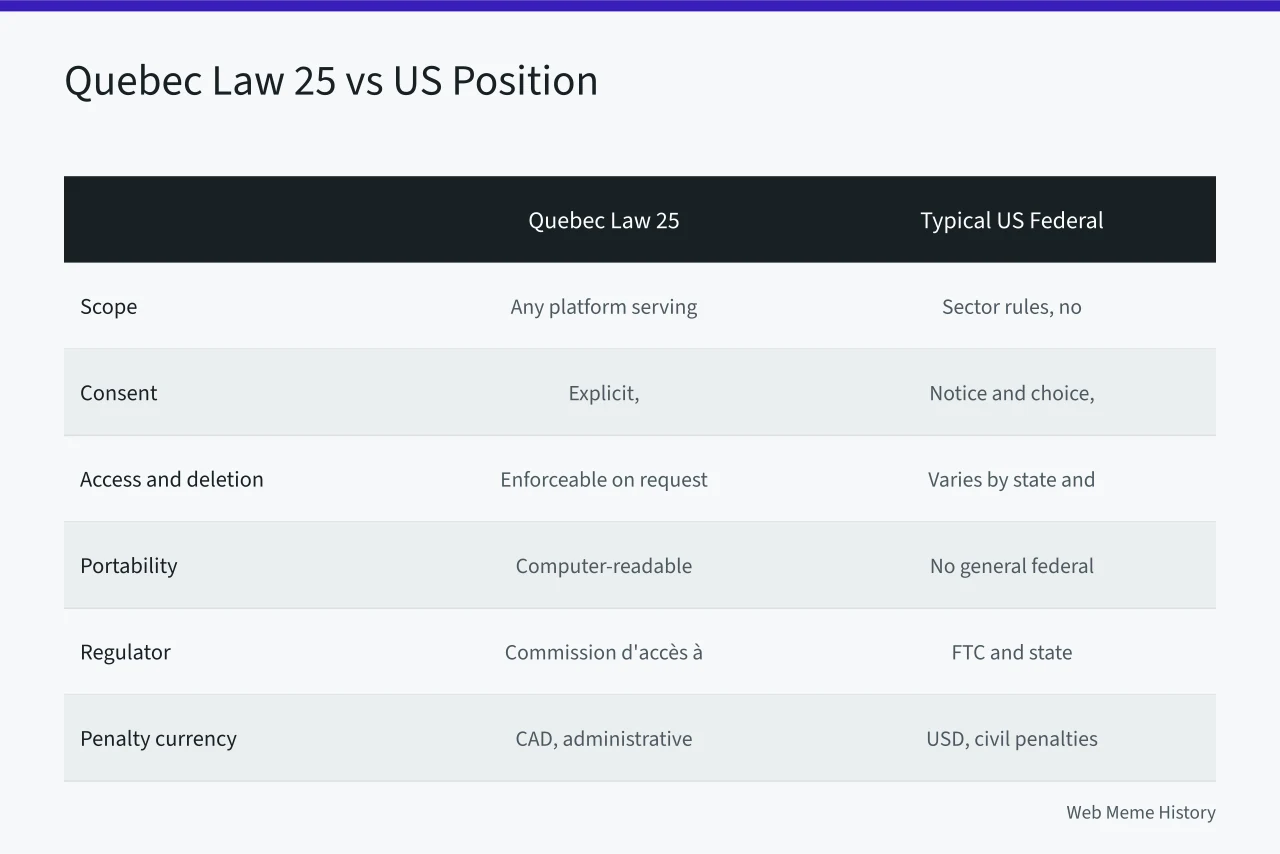
Quebec Law 25
- Scope
- Any platform serving Quebec residents
- Consent
- Explicit, purpose-specific, plain language
- Access and deletion
- Rights enforceable on request
- Portability
- Computer-readable format required
- Regulator
- Commission d'accès à l'information
- Penalty currency
- CAD, administrative fines
Typical US federal position
- Scope
- Sector rules, no general federal privacy statute
- Consent
- Notice and choice, often opt-out
- Access and deletion
- Varies by state and sector
- Portability
- No general federal right
- Regulator
- FTC and state attorneys general
- Penalty currency
- USD, civil penalties and consent orders
The US side is not empty. The FTC has acted on privacy for years, including a $5 billion penalty and new Facebook restrictions in 2019, documented in the FTC settlement announcement.
That case followed the Cambridge Analytica data scandal, which shaped US regulators' thinking on consent. The US still lacks one statute covering every platform that touches a resident's data.
Option by option
Option one: run one global flow built for the US market. This is the default for most platforms. It relies on notice and opt-out, and it treats deletion requests as a support ticket. It works where the only exposure is US federal and state law. It fails in Quebec the moment a resident asks for their data in a portable format, because there is no queue for that request.
Option two: extend an EU GDPR programme to Quebec. Teams that already run GDPR compliance often assume Quebec is a copy. The Quebec data protection comparison shows the overlap is real but not total: thresholds, breach notification timing and regulator contact points differ. Reusing GDPR paperwork without checking those points leaves gaps that a complaint will find.
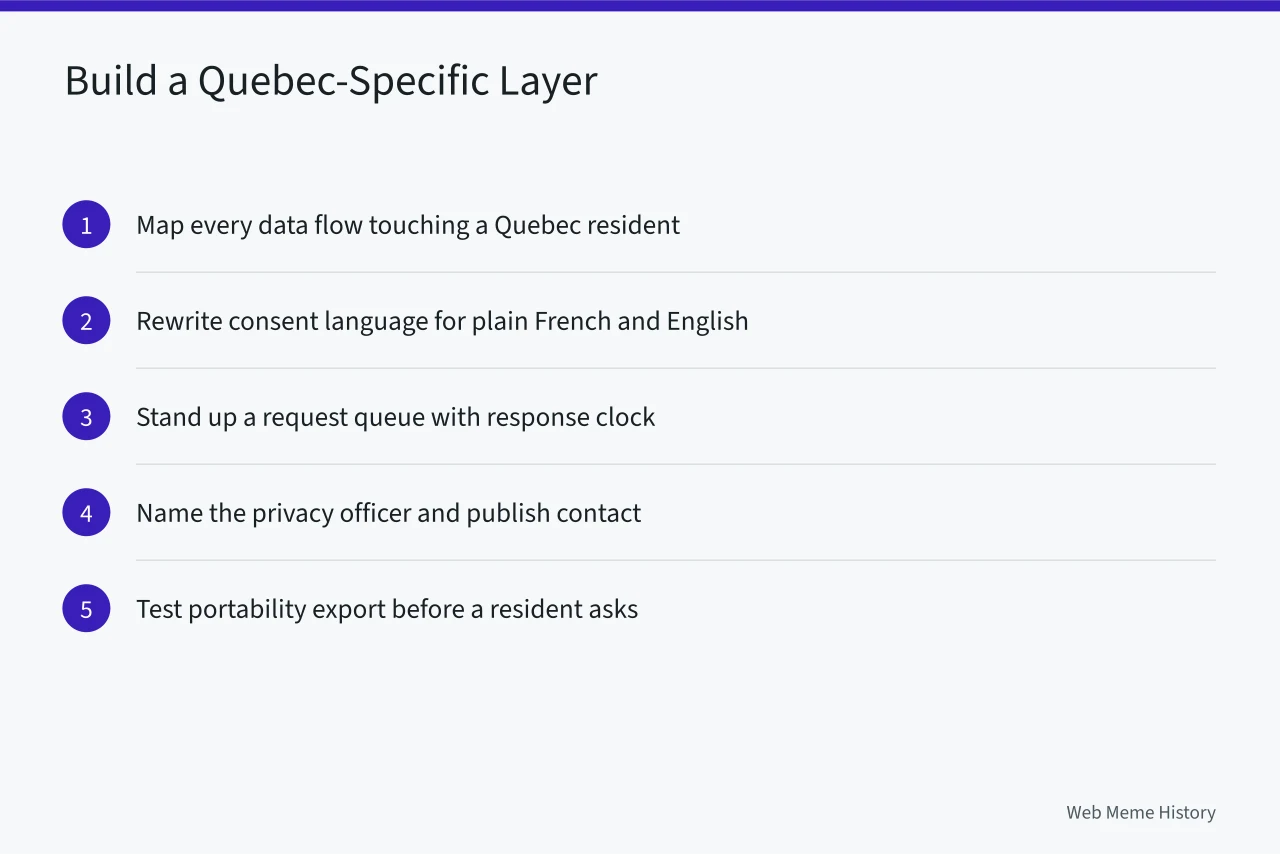
Option three: build a Quebec-specific layer. This means a separate consent record, a named privacy officer, and a documented process for access, correction and portability requests. It costs more up front. It also produces the evidence a regulator asks for first.
Where each one wins
Option one suits a platform with no Quebec users and no plan to acquire them. Option two suits a firm with a mature GDPR program and a small Quebec user base, if someone checks the divergences.
Option three suits any platform where Quebec residents are a real share of traffic. It is right because the layer costs less than an administrative penalty and the remediation order that follows it.
A short checklist helps decide which applies.
- Do we know how many Quebec residents use the service monthly?
- Can we produce a portable export on request today?
- Is a privacy officer named and reachable?
- Does our consent record show purpose, not just agreement?
What none of them solve
No option settles how a small platform proves it is not serving Quebec residents when its content is public and indexable. Law 25 turns on offering services to residents, and an open web page offers itself.
That is the shared limit: all three approaches assume a boundary the open web does not draw. The same problem appears in moderation debates, where platforms argue over reach and responsibility, as covered in what did Section 230 protect.
A second shared limit is enforcement capacity. The Commission d'accès à l'information publishes guidance, but investigations follow complaints. A platform that waits for a complaint is already behind. Reading how a comparable US settlement unfolded, traced in Facebook FTC settlement history, shows how quickly a narrow complaint becomes a broad audit.
A compliance programme built for one jurisdiction rarely survives contact with a second one unmodified.
Example: a mid-size platform with 40,000 Quebec users
A platform with a US-first consent flow and 40,000 monthly Quebec users runs the checklist above and finds two failures: no portability export and no named officer. The fix is not a rebuild. It is a request queue, a published contact, and an export script. The remaining work is documentation, which is what a regulator reads first.