Industry
Canada Online News Act Platforms: What Solo Publishers Face
Canada Online News Act platforms: Google pays through a collective, Meta blocks news links, and the two-journalist rule locks solo publishers out.
What to take away
- A one-person Canadian news site cannot bargain with platforms under the Online News Act, sign a platform deal under that law, or file for CRTC arbitration. Eligibility generally requires two or more journalists employed in Canada.
- Google pays Canadian news businesses through the Canadian Journalism Collective, which hands out the payments. Meta has blocked news links in Canada since August 2023.
- What still worksa domain you own, an email list, a full-text RSS feed, search traffic, and republication deals that earn credit links.
- Make a compromise only when it costs little money and under five hours a week. A weekday digest and a weekly reader Q&A both clear that bar.
- A second journalist is the one move that opens the bargaining route. The free path thins out around 30,000 to 50,000 monthly pageviews, an estimate rather than a published figure.
What the two-journalist rule rules out
A solo publisher sits outside the bargaining framework. Canadian Heritage sets out the eligibility conditions, and the journalist count settles most cases.
The count rules out three things: direct negotiation with Google or Meta under the Act, CRTC arbitration after failed talks, and a share of the money the Canadian Journalism Collective distributes. Audience size does not change it.
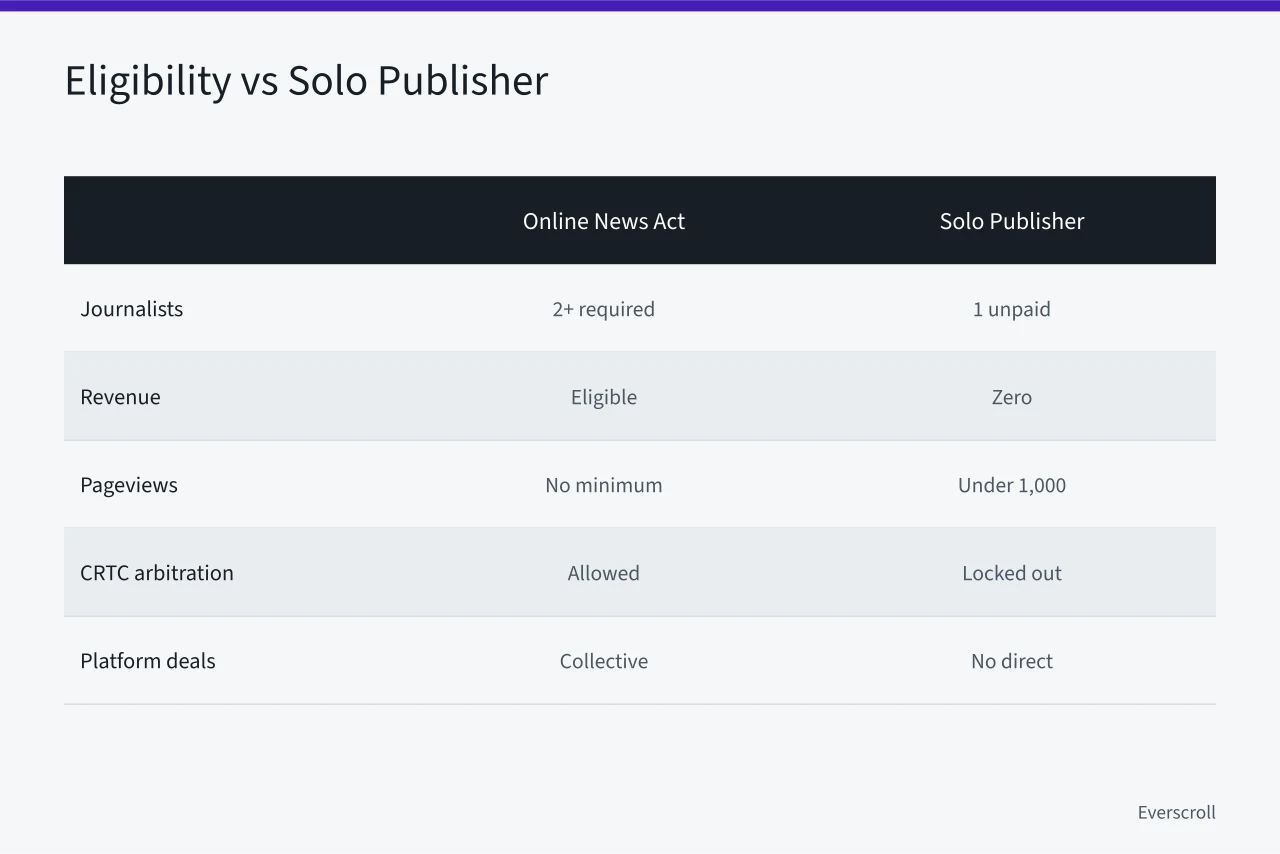
The Act governs payment, not permission to report. Nothing in it stops a solo site from publishing. Nothing in it obliges a platform to carry your links either.
What Google and Meta did under Bill C-18
| Actor | Current position | What it means for a solo site |
|---|---|---|
| Pays Canadian news businesses through a collective | The collective decides distribution, not you | |
| Meta | Blocks news links on Facebook and Instagram since August 2023 | Referral traffic from those apps does not return |
| CRTC | Arbitrates for eligible businesses stuck in bargaining | An ineligible site cannot open a file |
The Canadian Journalism Collective is the part solo publishers misread. It pools the platform payments and pays its members, and membership follows the Act's eligibility rules. No public route exists for a site that fails the test.
Platform positions move, and the public record is patchy. Before repeating a claim about the block or a payment, check the dated record of the Act and Canadian Heritage's own online news page. The habits in Policy news writing rules: eight habits that keep an entry from becoming a false claim matter if the Act becomes a beat you cover.
Why US policy watchers should track this
The Online News Act is Canadian, but the questions it raises reach US app and social media regulation. Who must carry news links? When may a platform block them? Who pays? Those questions sit inside the same platform power debates US readers follow.
For US readers, the useful lesson is not the Canadian thresholds. It is the structure. A platform mandate can create winners and losers, and a block can remove referral traffic overnight.
Workplace policy ties in here. If an employer lets staff post news links or run branded accounts, a platform ban can break that workflow.
A social media policy should name who owns the account, what happens when a platform blocks links, and whether the employer pays for news access. None of that depends on Canada's two-journalist test. It depends on the same platform power the Canadian case exposes.
What a solo publisher can still do
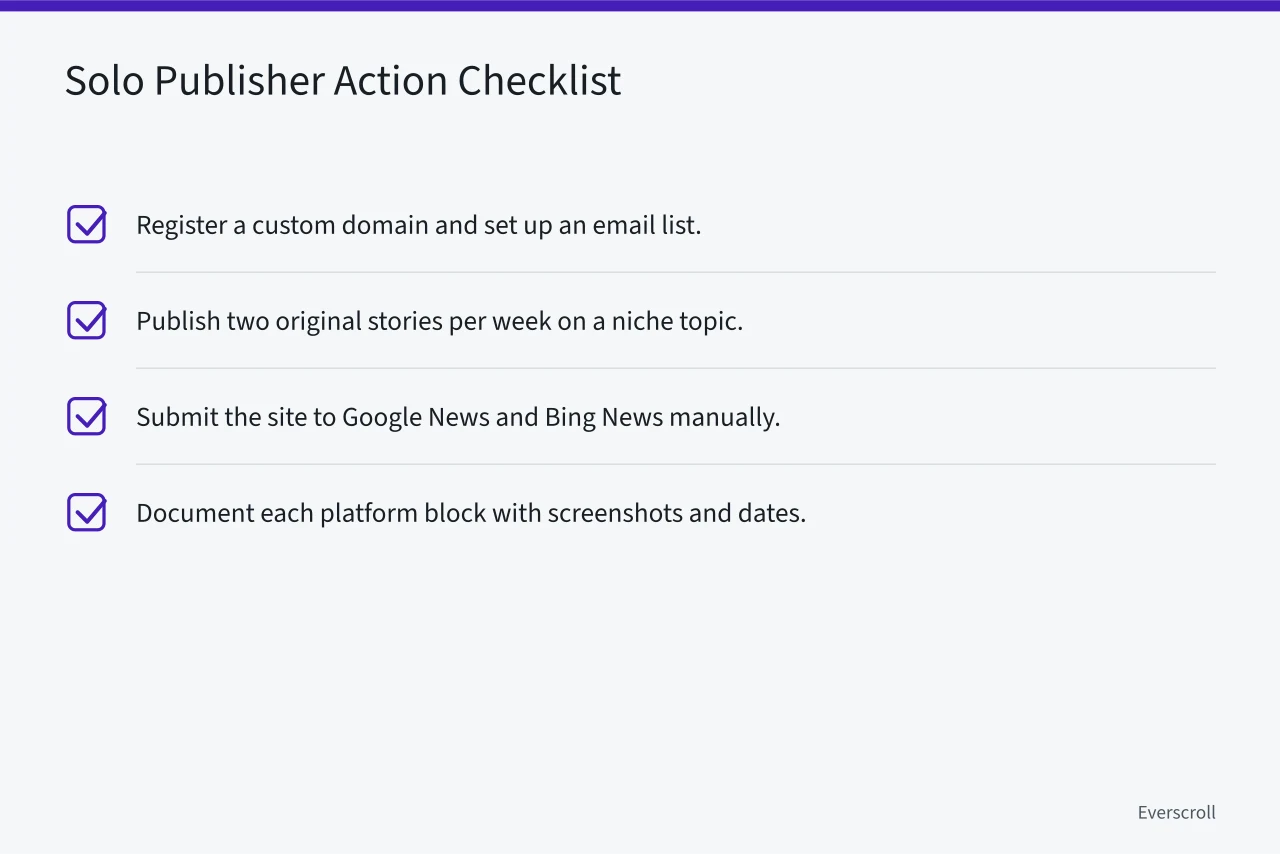
- Publish original reporting on a domain you control, so a block never removes your archive.
- Start the email list with the first story and keep the signup inside every article.
- Ship a full-text RSS feed so aggregators and other newsletters can carry you.
- Offer republication under a short licence that keeps your copyright and asks for a credit link.
Watching this file without reading everything is a scoping problem. How to scope a policy news watch before you drown in sources shows how to pick three sources and stop.
Turning readers into subscribers
Put a single-field email form inside the article, after the second subheading, where a reader has just learned the rule or the deadline. Repeat it once at the end.
Set your own line, for example two subscribers per 1,000 pageviews, and check it monthly. A footer form alone rarely moves that number.
Subscriber email is personal information. Canada's privacy law sets consent, purpose and breach notification duties, described on the Office of the Privacy Commissioner's PIPEDA page. A list of 90 readers is not exempt.
Compromises worth making
- A weekday digest of platform and CRTC news, capped at 250 words and written in 20 minutes.
- One reader question answered weekly, published with the sender's permission.
- One moderated comment thread on your biggest story, not comments on every post. A content moderation policy guide is only useful once you find the version that applied matters before you promise a thread you cannot police.
- The digest text cross-posted to a channel Meta does not control, with the link.
Stop all four when they take more than five hours a week, or when they eat reporting time.
Example: licence terms to refuse
Perpetual, irrevocable, worldwide, royalty-free licence to host, reproduce, modify and distribute all Publisher content, including content later unpublished, for any commercial purpose.
That wording is a composite of standard licence language, not a quote from a named contract. Perpetual covers your archive and everything you write next. Irrevocable means you cannot take it back when the payment ends.
Ask for a fixed term, a reversion clause and a credit link. If a platform refuses all three, no payment is worth it.
When the free path stops paying
Track pageviews and subscribers monthly. The 30,000 to 50,000 pageview estimate marks where ad revenue, freelance work and licensing value usually beat the cost of paid help. Your own numbers set the real line.
At that point, contract a regular freelancer or hire a second journalist. The second person puts the two-journalist test within reach, which is the only route into the framework.
Selling ads or hiring in Quebec adds language duties. Bill 96 and platform content in Montreal, what francophone managers must file covers what a commercial publisher there has to file.