
Rules
Bill 96 social media requirements in Quebec
Bill 96 social media requirements in Quebec cover French posting rules, agency contracts, compliance records, and enterprise-register filing steps.
What to take away
- Bill 96 social media requirements apply to commercial platform content a Quebec business publishes, not to private messages between friends.
- French must be markedly predominant in commercial publications, which shapes captions, hashtags, alt text and paid ads.
- Contracts with platforms, influencers and agencies need French clauses and a francization plan where the law requires one.
- Montreal agencies and francophone managers file and document compliance through French-language policies, proofreading logs and register filings.
- The Quebec enterprise register is where platform managers file and confirm the client's legal name, address and directors, plus the annual update declaration.
- Penalties are financial and can double for repeat offences, and enforcement now includes inspection powers.
What Bill 96 requires for commercial social media content in Quebec
Bill 96 amended the Charter of the French Language, and it reaches commercial content that Quebec businesses publish on social platforms. If a post promotes a product, service or event to Quebec consumers, it is commercial content. That covers a bakery in Rosemont announcing a new pastry and a Montreal software firm recruiting developers.
The regulator is the Office québécois de la langue française, known as the OQLF. Sections 58 and 58.1 of the Charter set the language rules for commercial publications and advertising, and section 59 lists the exceptions.
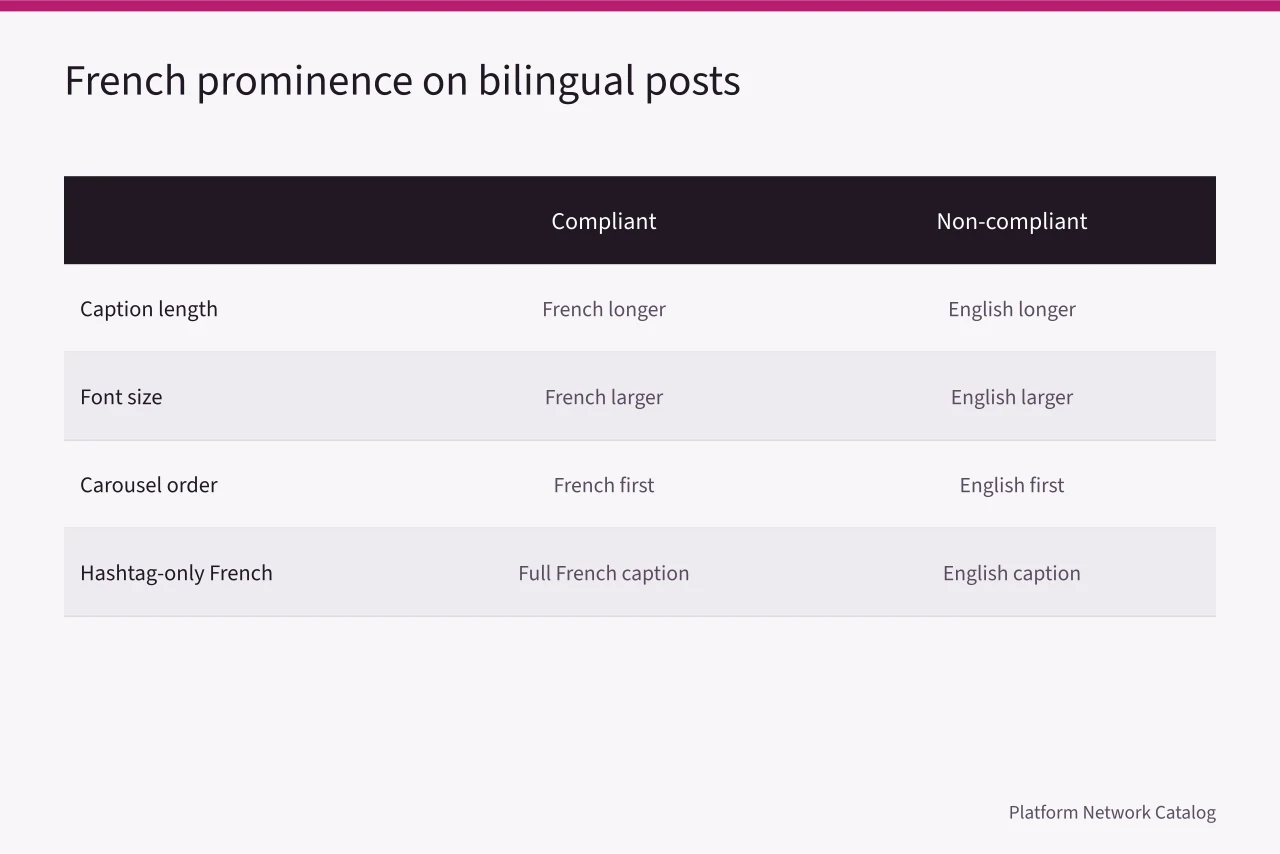
French must be present and predominant. On a bilingual post, the French version must be at least twice as prominent as the English, which affects caption length, font size in graphics, and the order of text in a carousel. A single English caption with a French hashtag does not meet that test.
Platforms themselves are not the regulated party in most cases. The business that publishes the content is. That distinction matters for community managers who run accounts on behalf of clients: the client carries the obligation, and the agency that produces the content can be drawn in through the contract.
The law also touches commercial publications that are not advertising, such as a brand's public page name, its slogan and its product descriptions. The Quebec culture ministry publishes guidance on French-language use in cultural and commercial settings that managers can consult when a campaign sits near the line.
Where a platform's own moderation or account decisions become the dispute, the route runs through the platform first, then the OQLF, as set out in our guide on how to File a Complaint.
French-language posting rules for platforms and agencies
French-language posting rules apply to captions, on-image text, video subtitles, alt text and paid ad copy. A practical rule for Montreal teams: write the French first, then adapt to English, so the French is not a compressed translation.
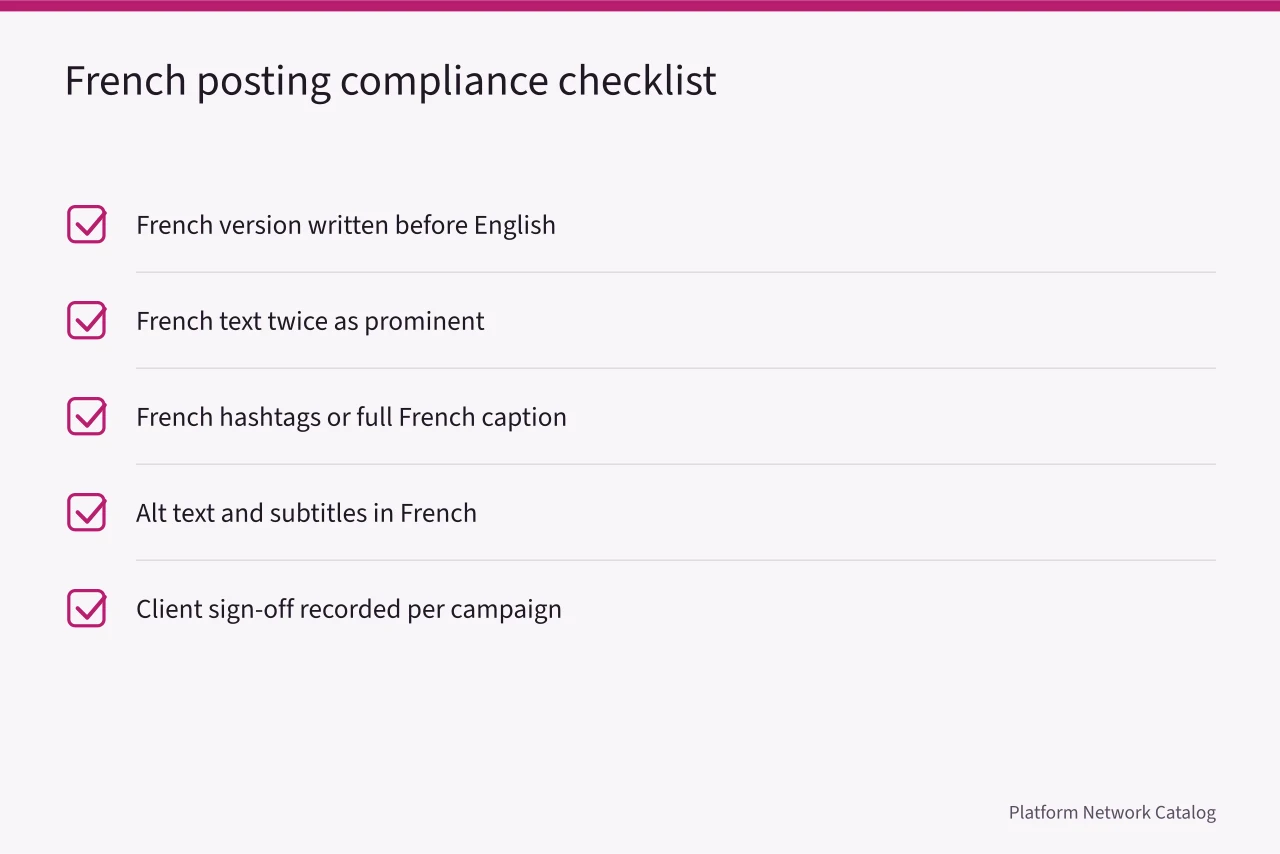
Hashtags count as text. A campaign that uses only English hashtags should add French equivalents or a French caption that carries the same message. Emoji do not replace words, and a French caption made only of emoji will not satisfy an inspector.
Some content is exempt. Posts aimed at an audience outside Quebec, internal communications, and content from a platform's non-commercial users fall outside the commercial publication rules. A Montreal agency posting for a client in Ontario should still check where the audience sits, because reach into Quebec can pull the post into scope.
For platform-side teams, the rules mostly bite through advertising tools and brand pages. Ad review processes in Quebec should flag English-only creative, and brand page names should carry a French version or a registered trademark that is exempt.
- French version written before the English version
- French text at least twice as prominent on bilingual creative
- French hashtags or a French caption carrying the full message
- Alt text and subtitles in French where the post is commercial
- Client sign-off recorded for each campaign
- Proofreading log kept with the date and the reviewer's name
- Register entry checked for the client's legal name and address
Contract terms and the Charter of the French Language
Charter of the French Language obligations flow into contracts between Montreal agencies, clients and creators. A services agreement should state which party is responsible for French adaptation, who bears the cost of a redo, and what happens when a platform rejects French creative.
Influencer agreements need the same treatment. If a creator posts English-only content for a Quebec brand, the brand can be exposed. Contracts should require French captions, a review step before publishing, and a takedown window if the content is found non-compliant.
Platform terms of service are not a defence. A platform's own language settings do not override Quebec law. Agencies that buy media on behalf of clients should keep the French creative in the same campaign as the English, not in a separate low-budget line that never runs.
Employment contracts inside a Montreal agency are also affected. Job postings that require French, francization committees in larger firms, and internal training records all support a compliance file if an inspector asks how the agency operates. Quebec's justice and civil status guidance covers the legal context for these obligations.
Francization obligations sit with the OQLF rather than the register. An enterprise with 50 or more employees must register with the OQLF and draw up a francization program, and one with 100 or more must also set up a francization committee. The OQLF issues a francization certificate once it accepts the program.
Campaign budgets belong in the contract conversation too, and the true cost of a bilingual contest is worth costing out before signing, as we set out in our guide to budgeting a Social Media Giveaway in Canada.
How Montreal agencies document compliance
Montreal agencies document compliance with a file that an inspector can read in one sitting. The core is a French-language policy that names the person responsible, the review steps, and the escalation path when a client refuses French adaptation.
Campaign files should hold the French and English creative, the sign-off, and the publishing schedule. Screenshots matter because posts get edited or deleted. A dated screenshot with the URL is stronger evidence than a description of what was published.
Agencies also keep a register of client legal names, Quebec enterprise numbers and the addresses used on filings. When a client changes its name or moves, the agency updates the file, because a mismatch between the register and the public page is an easy finding for an inspector.
Training records help. Short internal sessions on French-language posting rules, with attendance noted, show that the agency took the law seriously. So do written responses to client requests for English-only campaigns, even when the client gets its way.
Filing and registration steps with the Quebec enterprise register
Most Quebec businesses are already registered, but platform managers still need to check and update the record. The Quebec enterprise register is the public file that carries a business's legal name, address and directors. The Registraire des entreprises keeps the file and sets the filing deadlines. Here is the sequence Montreal teams follow.
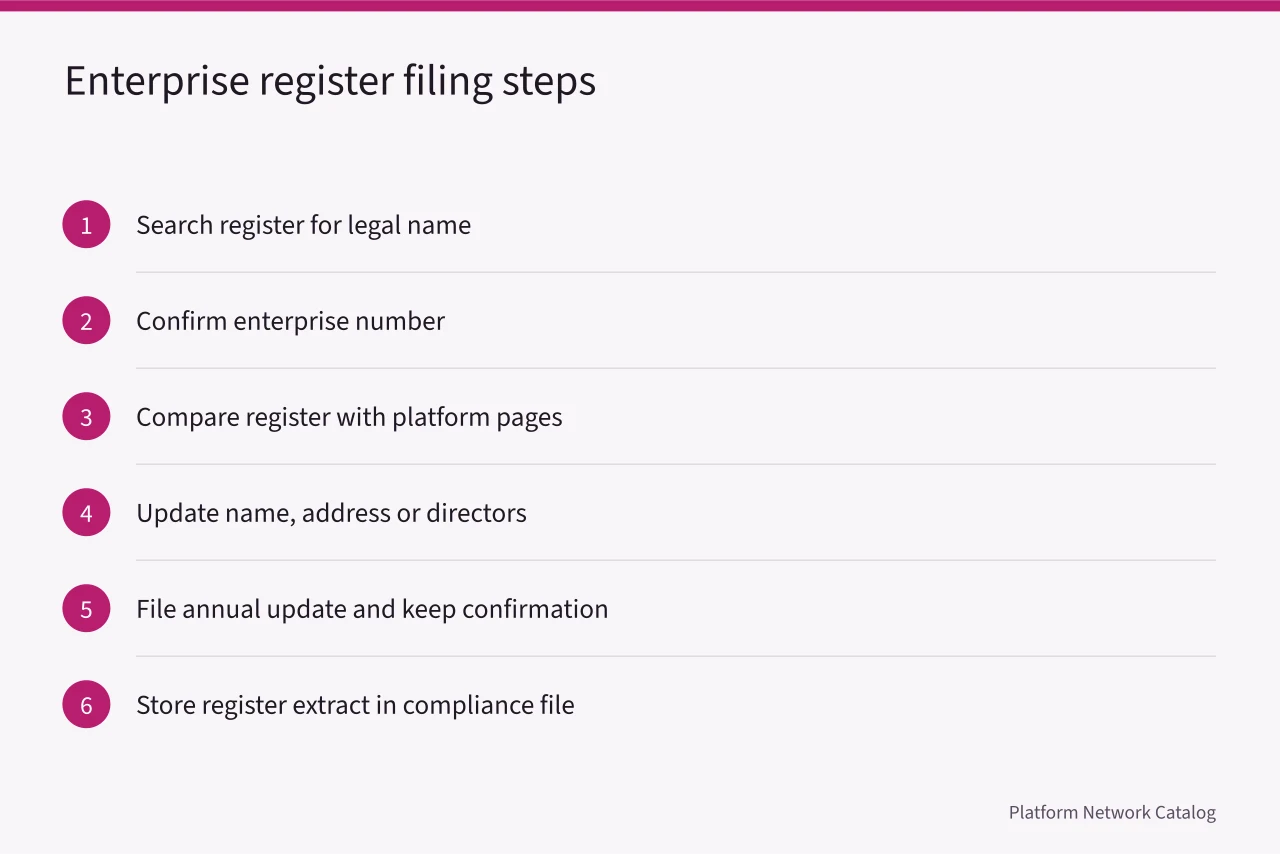
The businesses portal run by the Quebec government covers registration, updates and the documents a platform manager needs for a filing. Keep the extract current: an outdated address on the register is a common trigger for a follow-up letter.
Filing and registration steps
- Search for the client's exact legal name and note the Quebec enterprise number shown on the listing.
- If the client carries on business in Quebec and does not appear, file a declaration of registration (déclaration d'immatriculation) through the portal.
- Check the declared activities against the brand's platform pages and update the entry when the two no longer match.
- File the annual update declaration (déclaration de mise à jour annuelle) within three months of the fiscal year end, even when nothing has changed.
- File changes to the legal name, address or directors through the portal as they happen, rather than waiting for the next annual filing.
Fees are set in the Registraire's tariff and depend on the filing and the legal form of the business. Registration and the annual update declaration are priced separately, and the tariff changes from time to time, so confirm the current amount on the portal before paying.
The public search itself is free, and the enterprise register search shows the legal name, address and status that a brand page must match.
Penalties and enforcement for non-compliance
Penalties under the Charter are financial. Fines are set per offence, a second offence within two years carries a higher minimum, and directors can be held responsible in some cases.
Bill 96 set the range in 2022 at $3,000 to $30,000 for a natural person and $6,000 to $90,000 for a legal person. The amounts are indexed each year, so the range in force for 2025 is higher than those figures.
Enforcement comes through inspections and complaints. Any person can report a commercial publication that is not in French, and the OQLF can open a file. That is separate from platform complaint routes, which handle content that breaks a platform's own rules rather than Quebec language law.
A practical response to a complaint is a documented fix: the French creative, the date it went live, and the change made. Agencies that cannot show that response often face a longer process and a wider review of past campaigns.