
Rules
Ottawa and Winnipeg public sector social media rules compared
Public sector social media rules Canada differ by city: Ottawa leans on federal bilingual and procurement practice, Winnipeg on Manitoba records and local B2B.
What to take away
- Public sector social media rules Canada sets two different working environments: Ottawa teams answer to federal language and procurement expectations, Winnipeg teams to Manitoba records and access rules.
- Ottawa's own social media policy covers account approval, monitoring and records, and it is the clearest municipal model to copy in either city.
- Manitoba's access and records laws, FIPPA and The Archives and Recordkeeping Act, shape how Winnipeg public sector and nonprofit teams buy tools and publish.
- Bilingual publishing is a legal duty for federal Ottawa teams; in Winnipeg it is a policy choice tied to audience data.
- Both cities require retention and access handling that most social platforms do not provide out of the box.
- Both cities need a named delegate who can approve a post when the usual signer is away.
Why Ottawa and Winnipeg public sector social teams face different constraints
Ottawa is a company town for the federal public service. Social teams there sit close to bilingual obligations, security screening and federal procurement habits, even when they work for a municipal body, an association or a nonprofit. That proximity shapes hiring, vendor lists and approval speed.
The City of Ottawa publishes its own Ottawa social media policy, covering account registration, monitoring, content standards and records. It is the most concrete municipal example in this comparison, and it is worth reading before you write your own rules.
The City of Winnipeg Social Media Policy and its Social Media Guidelines are the named Winnipeg rules. They cover official account approval, monitoring and employee use, with new city accounts cleared through Corporate Communications. Nonprofits do not fall under the policy directly, but Winnipeg funding agreements often copy its account approval and monitoring duties.
Winnipeg sits in a Prairie market with strong local media and a business base in agriculture, manufacturing and logistics. Public sector and nonprofit teams there are smaller, so one person often handles publishing, records and vendor contact at once.
The Manitoba business portal shows how the province presents itself to companies, and that tone carries into how Winnipeg public bodies and their partners communicate on social channels. Local B2B buyers expect plain, factual posts rather than campaign language.
Language pressure differs too. Ottawa teams routinely work in English and French. Winnipeg teams work mostly in English, with French, Tagalog and Indigenous language needs appearing in specific programmes rather than across every channel.
None of this makes one city easier. It means the same post can trigger different checks depending on where the account is registered and who funds it.
Procurement rules and vendor approval in each city
In Ottawa, social media tools are usually bought through a competitive process or an existing standing offer. A new scheduling platform may need security review, accessibility review and a privacy assessment before anyone signs. Vendors without Canadian data hosting or French-language support often fail early.
Ottawa and Ontario buyers typically use the city's own tender listings, MERX or the Ontario Tenders Portal. Federal buyers use CanadaBuys, standing offers and supply arrangements.
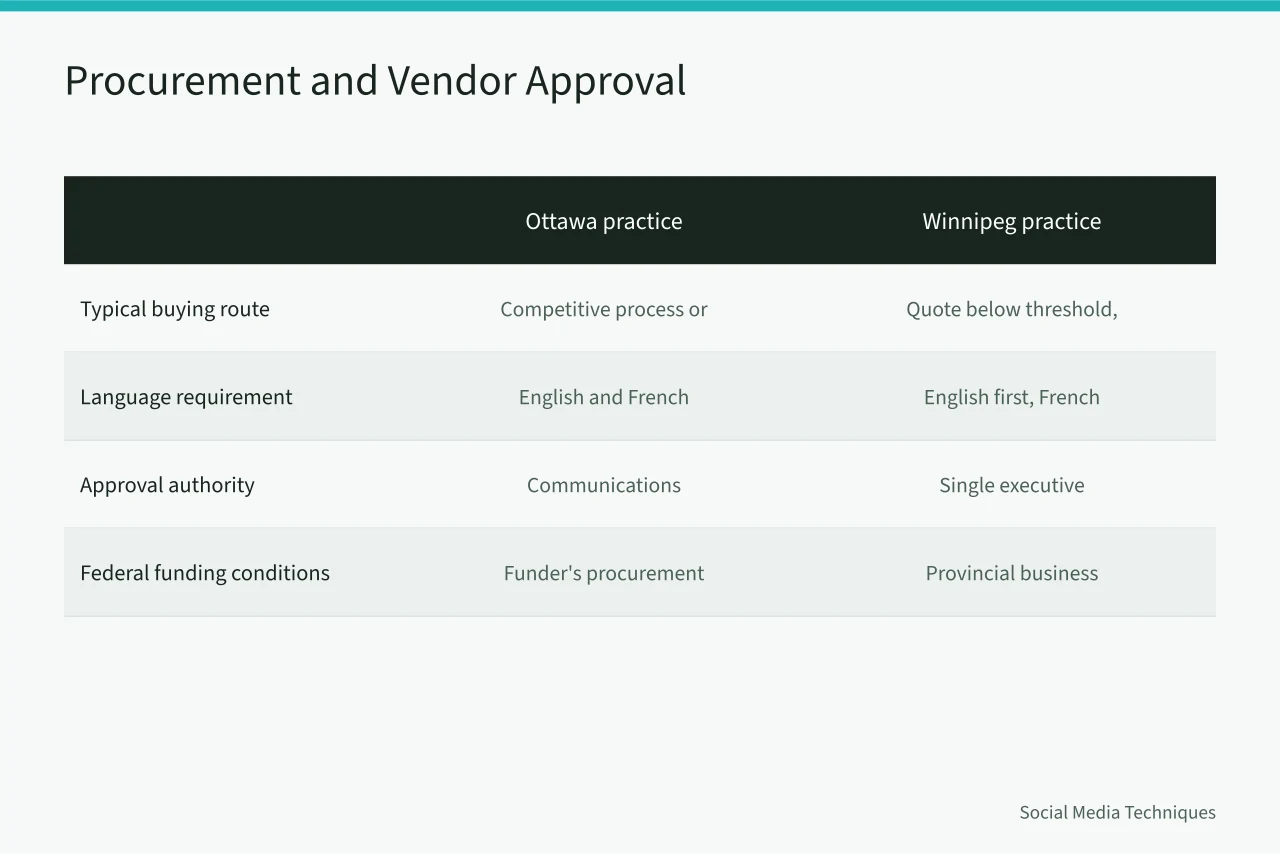
Federal money adds conditions. Teams receiving federal grants or contributions may have to follow the funder's procurement and branding rules, which can override internal preferences. That is common for associations running public awareness work in the capital.
Winnipeg follows Manitoba's procurement rules. Manitoba's Procurement Services Branch publishes the thresholds provincial departments use. Each city department, school division and nonprofit sets its own figure in policy, commonly in the low thousands of dollars for informal quotes, with a formal tender above it.
The City of Winnipeg posts its own opportunities on Bids and Tenders and applies Purchasing By-law No. 68/2010 to city purchases. Typical Winnipeg nonprofit thresholds run about $5,000 CAD to $10,000 CAD for informal quotes, with a formal tender above about $50,000 CAD. These are typical ranges, not a single city-wide figure.
The provincial business portal is the starting point many vendors and buyers use to understand registration and contracting expectations.
Procurement constraints also cover who may approve spending. In Ottawa, a communications director rarely signs alone. In Winnipeg, a single executive director at a nonprofit may hold that authority, which speeds decisions but concentrates risk.
Procurement rules and vendor approval
Ottawa practice
- Typical buying route
- Competitive process or standing offer
- Language requirement in contracts
- English and French support expected
- Data location questions
- Raised early for federal work
- Approval authority
- Layered, director plus procurement
- Records clause in contract
- Common
Winnipeg practice
- Typical buying route
- Quote below threshold, tender above it
- Language requirement in contracts
- English first, French where required
- Data location questions
- Raised mainly for health or personal data
- Approval authority
- Often one senior signer
- Records clause in contract
- Less common, added case by case
Both cities share one trap: buying a tool for publishing and only later asking whether it can export records. Add that question before shortlisting vendors.
Bilingual publishing duties: federal Ottawa versus Manitoba practice
Federal institutions in Ottawa must publish in English and French under the Official Languages Act. That duty covers social posts, not just websites. A campaign that runs only in English can draw complaints and must be corrected quickly.
The duty applies to institutions, not to every association. A national association in Ottawa may still choose bilingual publishing because its members expect it, and because federal funders ask. In practice, many treat it as mandatory.
Manitoba provides provincial services in French under its French Language Services Policy. The policy applies where numbers warrant, and the Francophone Affairs Secretariat publishes the policy and the list of designated offices and services. Demand in the service area decides, not a province-wide number.
Winnipeg nonprofits serving francophone communities often mirror that approach on social channels without a blanket rule.
Statistics Canada census data helps teams decide where French, Tagalog or Indigenous-language content earns its cost. The census gives mother tongue and language spoken at home by region, which is more useful than guesswork for planning campaigns.
Translation quality matters more than volume. A machine translation posted without review can create a records and complaints problem in Ottawa and a trust problem in Winnipeg. Budget for a reviewer, not just a tool.
One practical rule: write the French version first for federal Ottawa accounts. It forces shorter sentences and clearer structure, and the English version usually improves as a result.
Records retention and access-to-information obligations
Social posts are records in both cities. Comments, direct messages and deleted posts can all fall within a request. Teams that treat platforms as disposable channels get caught when a request arrives.
Ontario's Municipal Act, 2001 requires every municipality to adopt a records retention by-law. The City of Ottawa's retention by-law and its corporate records schedule set how long each class of record, including social media, is kept.
Federal bodies in the city follow Library and Archives Canada retention schedules and the Access to Information Act. Typical retention classes for campaign content run from two years after the post to the life of the account.
Manitoba public bodies follow The Archives and Recordkeeping Act, which requires records to be kept and disposed of under schedules approved by the Provincial Archivist. The Freedom of Information and Protection of Privacy Act, known as FIPPA, governs access and privacy.
Winnipeg teams should confirm whether their nonprofit is covered directly or through a funding agreement that imports records duties.
Most platforms do not export a complete, timestamped archive on demand. Plan for screenshots, exports and a written log of account activity. Build common social media strategy questions into your routine so you know the export works before a request lands.
Access requests have deadlines. A slow export can turn a routine request into a breach of the response timeline. Name one person who owns the process and one backup.
Deleted content is the hardest part. If your policy allows deleting abusive comments, record what was removed and why. A short note is enough, and it protects the team later.
Working with associations and nonprofits under public sector rules
Associations and nonprofits in both cities often run public campaigns with government money. That funding brings public sector duties into a private organization, and the funding agreement is where they appear.
Governance starts at the board. A nonprofit social media policy should state who approves accounts, who speaks for the organization and how staff separate personal and official accounts.
In Ottawa, associations frequently coordinate with federal departments on messaging. That means review cycles, bilingual assets and careful handling of political content during election periods.
In Winnipeg, associations lean on local media and community partners. Relationships matter more than paid reach, and a single well-placed post with a partner organization can outperform a campaign.
The Bank of Canada's public engagement work is a useful reference for tone. It shows how a public institution explains complex topics on social channels without jargon or hype.
Nonprofits should also check whether they fall under PIPEDA for personal information collected through social channels. PIPEDA requires personal information used to make a decision about an individual to be kept at least two years. Consent language in contests and sign-up forms is a common gap.
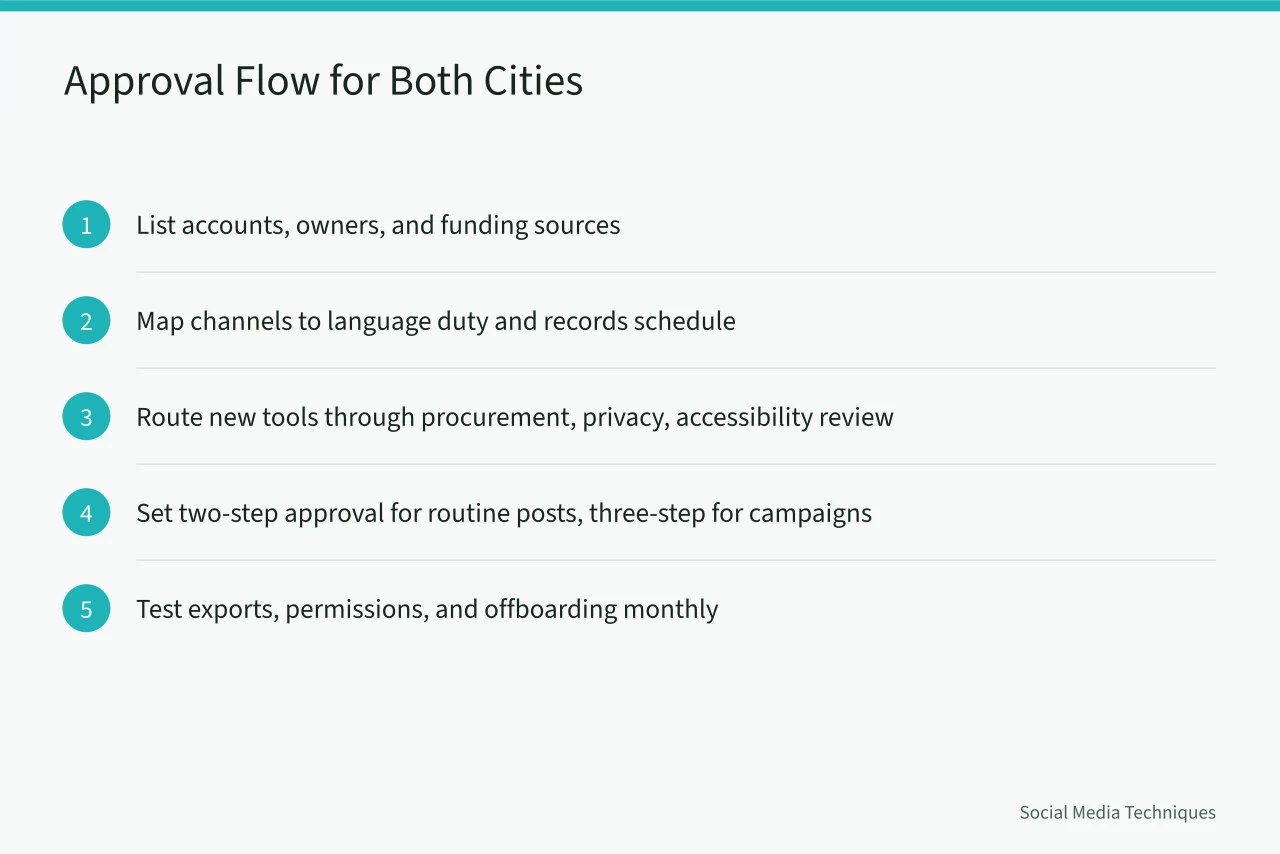
Accessibility is part of the flow in both cities. Alt text, captions and plain language are expected for public accounts, and they reduce translation errors as a side effect.
The British Columbians and our governments page is a useful cross-province reference for how public bodies describe their own rules. Read it for wording, not for Ottawa or Winnipeg requirements.
Ottawa and Winnipeg public sector social media rules checklist
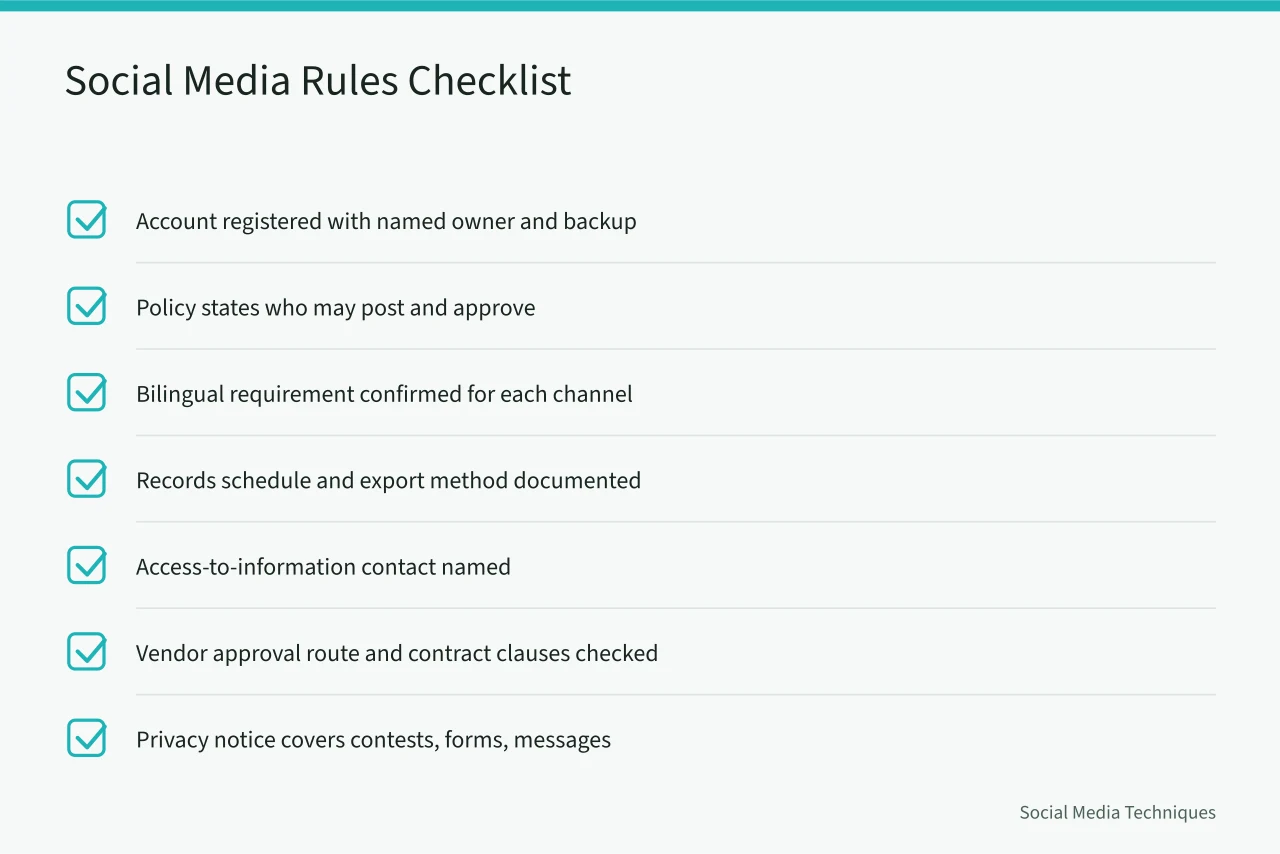
- Account approvalwho signs off on a new account and on each campaign.
- Language versionEnglish, French or another language, decided before drafting.
- Funding sourcethe grant, contract or city budget that pays for the work.
- Retention classthe schedule the account's records fall under.
- Export testa dated export you have run, not one the vendor promised.
- Delegatenamed in writing, with a backup for leave and emergencies.
Add a short review each quarter. Rules change when governments change, and a checklist that is never updated becomes a liability.
Worked example: the same post in Ottawa and Winnipeg
A city-funded nonprofit wants to announce a new winter programme on its main account. The post is the same in both cities. The approval and records path is not.
Ottawa path
- Draft and language
- French version first, then English, both reviewed
- Approval
- Account owner, then city communications director, then the funding officer
- Buying check
- Scheduling tool covered by the funding agreement and the city standing offer list
- Records and export
- Post, comments and approval email filed under the city retention by-law class
Winnipeg path
- Draft and language
- English first; French only if the programme sits in a designated French-language service area
- Approval
- Executive director signs, with a named delegate on file
- Buying check
- Tool bought under the body's own quote threshold
- Records and export
- Same set filed under the FIPPA and Archives and Recordkeeping Act schedules
Two approvals, two schedules, one post.