Rules
Social media accessibility requirements differ across US states
Social media accessibility requirements vary by US state, and most of the exposure comes from older civil rights law rather than a dedicated federal rule.
What to take away
- No federal statute names social media captions or alt text. The duty comes from the ADA, Section 508 and state civil rights law.
- California's Unruh Act and New York's Human Rights Law drive most private complaints against businesses.
- Illinois, Colorado, Massachusetts, Washington and Texas rely on general public accommodation laws.
- Florida and New Jersey do the same; some state IT policies name WCAG 2.0 Level AA for agencies.
- The Justice Department's 2024 Title II rule names WCAG 2.1 Level AA for public entities, with dates in April 2026 and April 2027.
- A compliant statement names the standard, its version, the audit date and the tester.
- The usual remedy is an order to fix the content plus attorney's fees.
Who has jurisdiction over a social post
No federal statute mentions captions, alt text or image descriptions. The duty arrives through older civil rights law applied to digital content.
Title II of the ADA covers state and local government. Title III covers places of public accommodation, which courts have read to include business websites and the accounts those businesses run.
California's Unruh Act, at Civil Code section 51, applies to business establishments. New York's Human Rights Law, at Executive Law section 296, covers employers and places of public accommodation. Settling scope before choosing channels saves rework, and social media strategy questions treats that order as the first decision.
The ADA resources page collects the settlements and guidance that show how the Justice Department reads the statute.
Section 508 governs federal agencies and their vendors. The laws and policies overview shows how those standards reach state procurement, where agencies often copy them.
What must be disclosed
Two documents carry the duty. The first is the post: alt text on images, captions on video and a transcript for audio.
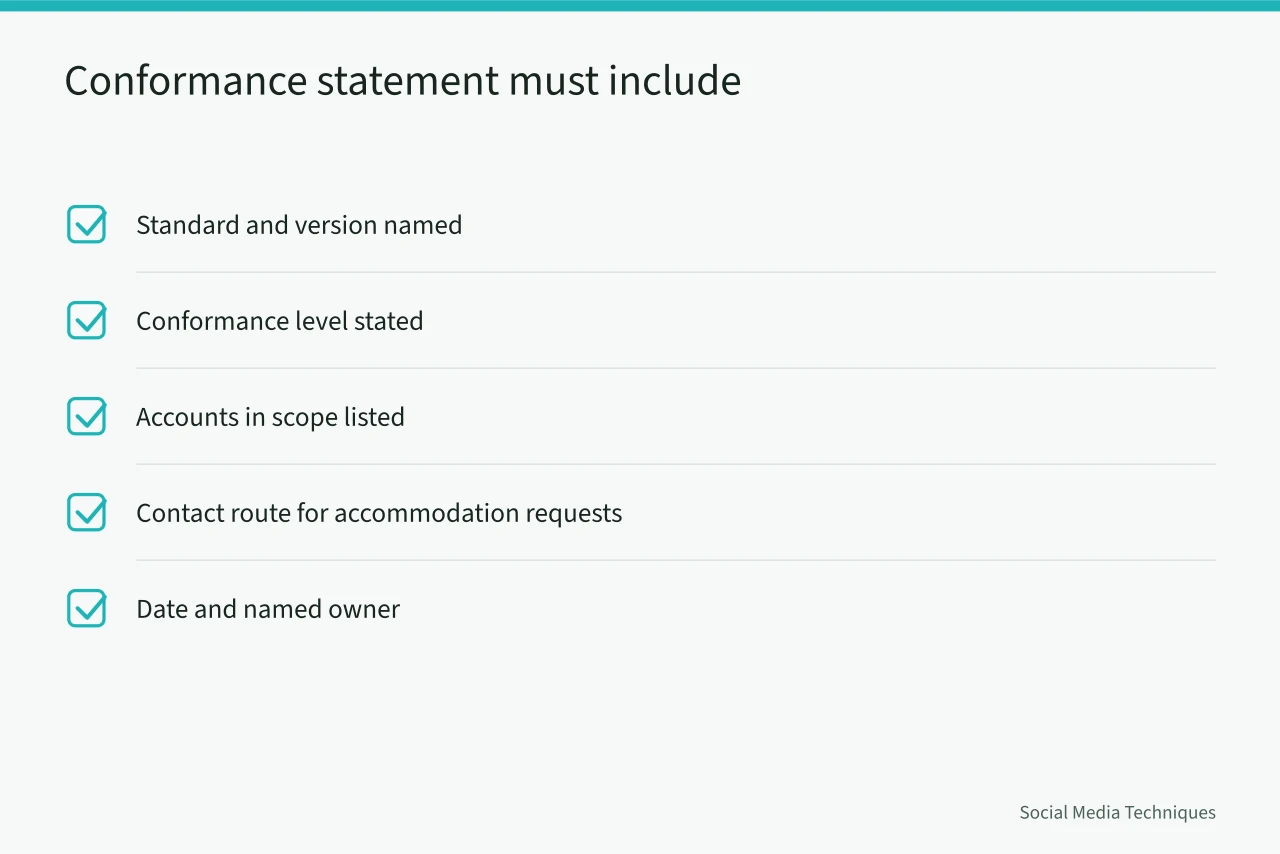
The second is a conformance statement. A usable one names the standard and its version, states the conformance level, lists the accounts in scope and gives a contact route for accommodation requests. It carries a date and a named owner.
WCAG 2.1 Level AA is the benchmark most US policies cite. The WCAG standards page sets out the success criteria, including non-text content and captions.
A statement that says "we are accessible" without a standard, a version and an audit date is not a claim a lawyer can defend.
Records to keep when a post is challenged
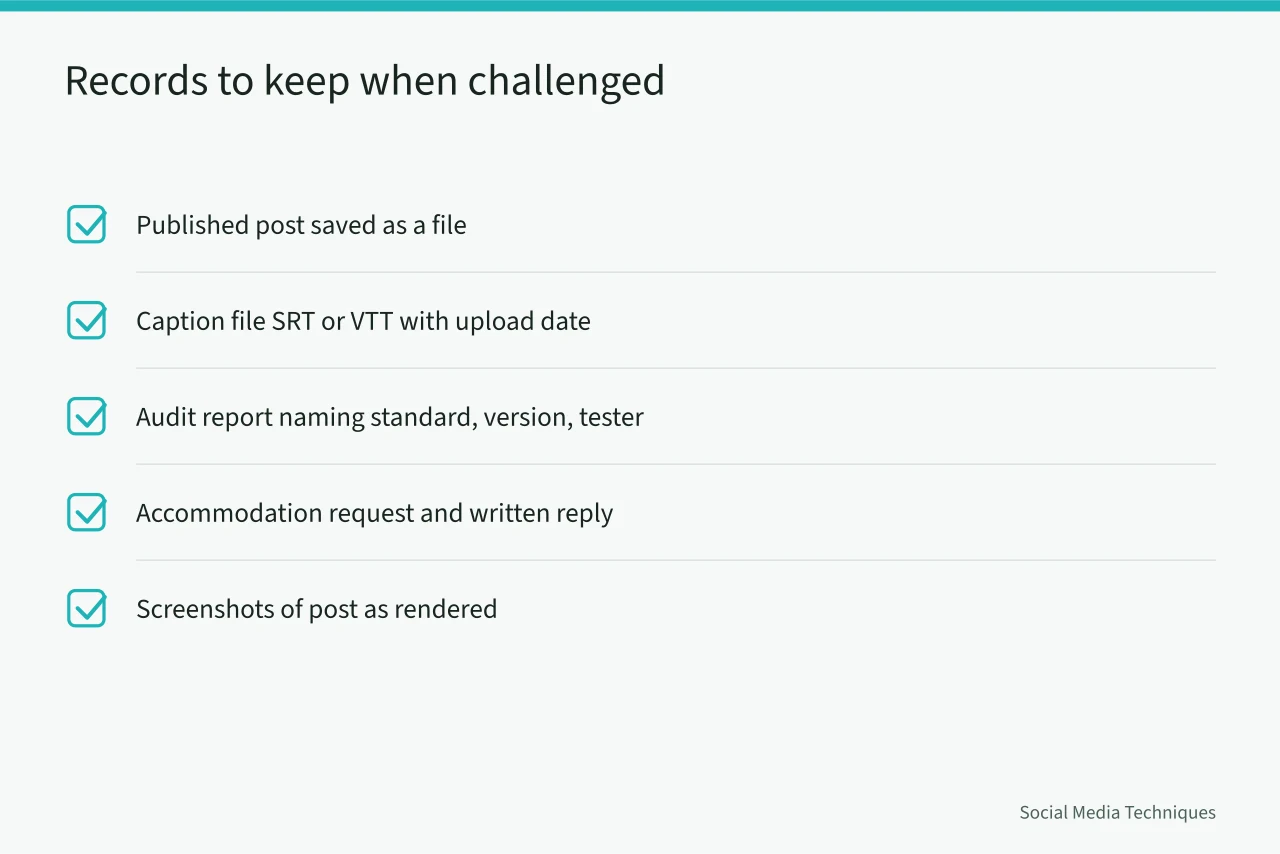
- The published post saved as a file, not a live link.
- The caption file (SRT or VTT) and its upload date.
- The audit report naming the standard, version and tester.
- Any accommodation request and your written reply.
- Screenshots of how the post rendered the day it went live.
Claims can be filed years after publication, so keep records for at least the state limitations period. A social media management routine that deletes old posts on a schedule quietly removes the evidence you would need.
State social media accessibility rules
| State or rule | Statute | Who it covers | Standard named | Where a complaint goes |
|---|---|---|---|---|
| California | Unruh Act, Civil Code 51 | Businesses and public accommodations | None in the text; courts treat WCAG as evidence | State superior court, Civil Rights Department |
| New York | Human Rights Law, Executive Law 296 | Employers and businesses | None in the text; WCAG used as evidence | Division of Human Rights, state court |
| Illinois | Human Rights Act, 775 ILCS 5; IITAA | Businesses, state agencies, public universities | IITAA names WCAG 2.0 AA for state entities | Illinois Department of Human Rights |
| Colorado | Anti-Discrimination Act, C.R.S. 24-34-301; HB 21-1110 | Businesses, state and local agencies | HB 21-1110 sets a state web standard for agencies | Colorado Civil Rights Division |
| Massachusetts | Anti-Discrimination Law, M.G.L. c. 151B; EOTSS policy | Businesses, state agencies | EOTSS policy names WCAG 2.0 AA for state agencies | Massachusetts Commission Against Discrimination |
| Washington | Law Against Discrimination, RCW 49.60; OCIO Policy 188 | Businesses, state agencies | OCIO Policy 188 names WCAG 2.0 AA for state agencies | Washington State Human Rights Commission |
| Texas | Human Rights Act, Texas Labor Code Ch. 21 | Businesses and public accommodations | None in the text | Texas Workforce Commission Civil Rights Division |
| Florida | Civil Rights Act, Fla. Stat. 760.01 | Businesses and public accommodations | None in the text | Florida Commission on Human Relations |
| New Jersey | Law Against Discrimination, N.J.S.A. 10:5-1 | Businesses and public accommodations | None in the text | New Jersey Division on Civil Rights |
| Federal, government bodies | ADA Title II, 28 CFR Part 35 | State and local agencies, public universities | WCAG 2.1 Level AA | Justice Department review, private suit |
| Federal, contractors | Section 508 | Federal agencies and their vendors | WCAG 2.0 Level AA | Agency complaints, procurement remedies |
Most states publish no rule aimed at marketing accounts. They apply a general civil rights statute or import a standard through procurement, so one uncaptioned video can be actionable in California and unaddressed in Wyoming. Accessibility checks belong inside social media content planning, where caption files are created, not in a review after publishing.
What happens if you do not comply
The usual remedy is an order to fix the content, plus the other side's attorney's fees. California's Unruh Act adds statutory damages per offense, so one uncaptioned campaign can draw claims in two states at once.
State agencies act as well. New York's Division of Human Rights can investigate a complaint and order changes to a policy or practice. The state consumer protection office directory helps you find the agency handling complaints in your state.
For public bodies, the 2024 Title II rule sets dates. April 2026 applies to entities serving 50,000 people or more, and April 2027 to smaller ones. Logging caption coverage inside four separated measurement layers makes those dates easier to track.
Example: the same uncaptioned clip in two states
Take a 40-second product video with no captions, run as a paid post in California and New York.
In California, a reader files in state court under the Unruh Act, where damages and fees are available. In New York, the same reader can file with the Division of Human Rights or sue under the Human Rights Law.