
Industry
How Seattle trust and safety teams shape US platform rules
Seattle trust and safety teams at major platforms turn local decisions into US rules. Here is how memos, FTC pressure and Section 230 shape them.
What to take away
- Seattle trust and safety teams sit inside the engineering campuses of the largest US platforms, where moderation policy is written.
- Their memos become US platform rules when legal, policy and product staff sign off and ship code that applies nationwide.
- The FTC enforces platform conduct through consent orders and privacy actions, giving Seattle teams a federal deadline to design against.
- Section 230 remains the legal backdrop that lets platforms remove content without becoming liable for everything users post.
- Seattle teams cannot fix offline harm, political pressure or the gap between a written rule and what a classifier catches.
Why Seattle became the trust and safety capital of US platforms
Seattle is not Washington, DC, and it is not Silicon Valley. It is where some of the largest platforms put the teams that write the rules. Amazon, Microsoft, Meta and Google all run substantial engineering and policy operations in the Seattle area.
The concentration is not accidental. Washington State has no state income tax, a deep pool of engineers, and a regulatory climate that has, so far, been easier to work with than California's.
That matters for platform policy Seattle because the people who write enforcement guidance sit near the people who ship the classifiers. A rule drafted in Seattle can be tested against live traffic the same quarter. A rule drafted in a distant policy office often cannot.
Seattle's influence also runs through Washington State law. The My Health My Data Act, passed in 2023, restricts how platforms handle health data. The state has debated age-appropriate design rules that mirror California's AADC. Teams in Seattle track these bills because a state rule can become a national product change.
The teams inside Seattle platforms and what they actually decide
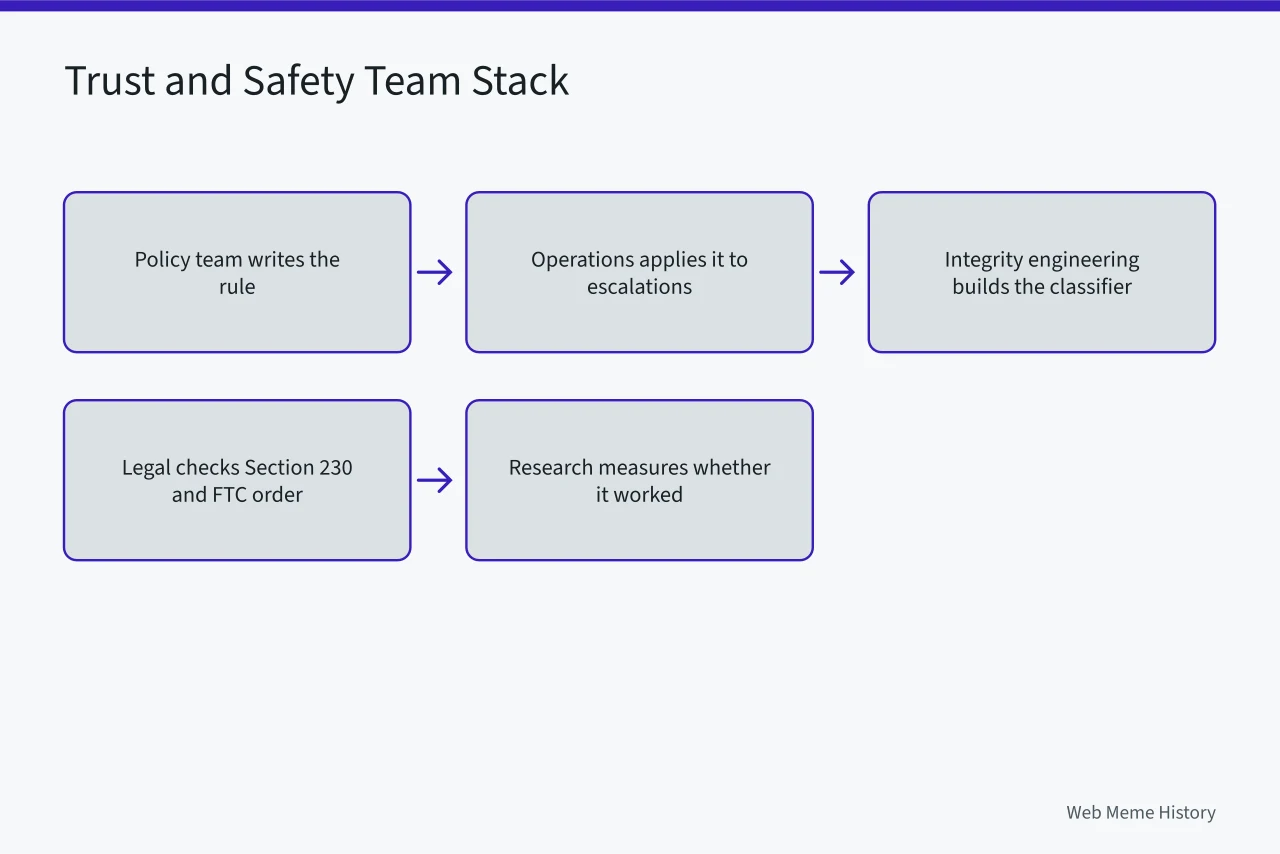
At Amazon, the trust and safety work runs through fraud, counterfeit and review abuse. At Microsoft, it covers Xbox, LinkedIn and Bing. At Meta's Seattle offices, it touches integrity work on Facebook and Instagram. At Google's Kirkland campus, it touches YouTube and Search policy.
Each team decides a narrow question: what does the rule say, and what happens when the classifier is wrong?
Those decisions are not abstract. A Seattle team deciding how to label election misinformation is deciding what millions of US users see in their feeds. A Seattle team deciding how to handle teen accounts is deciding what a 15-year-old in Ohio can find.
What a Seattle policy memo actually contains
A typical memo names the harm, the proposed rule, the enforcement mechanism, the appeal path and the measurement plan. It is not a press release. It is a design document. If the memo is approved, it becomes a ticket in the integrity engineering backlog. If it is not approved, it becomes a note for the next quarterly review.
How a Seattle policy memo becomes a US platform rule
The path from memo to national rule is slower than outsiders think. Here is the usual sequence.
- A Seattle trust and safety researcher flags a harm pattern using internal data and outside research, such as Pew internet and technology research on US platform use.
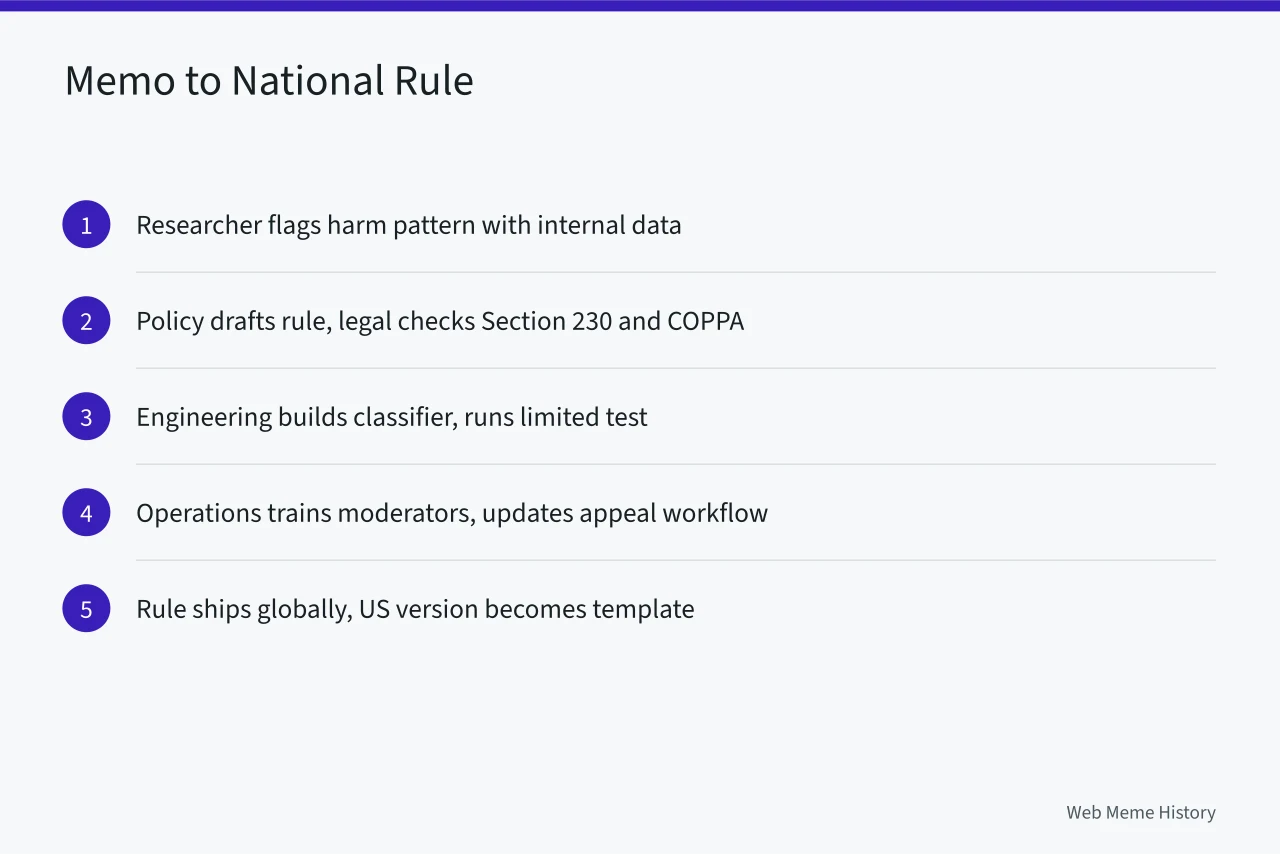
- Legal review checks the proposal against Section 230, COPPA, state privacy laws and any open FTC consent order.
- Policy and legal sign-offa named owner approves the rule text, the enforcement threshold and the appeal path.
- Code shipengineers build the classifier, the appeal flow and the audit logging, then ship the rule behind a limited test.
- National rolloutthe rule applies to all US users, and the team reports the metrics each quarter.
That sequence is why a Seattle decision can become a US rule in a quarter or less. It is also why a bad decision can become a national problem just as fast.
Worked example: teen accounts
Instagram Teen Accounts is the clearest recent case. Meta announced the change on 17 September 2024 for the US, UK, Canada and Australia. Accounts for users under 18 default to private, and users under 16 need a parent's permission to loosen a setting.
Messaging defaults to accounts the user follows, sensitive content is filtered, and a 60 minute reminder plus a sleep mode from 10pm to 7am apply. Meta said the four launch countries would be covered within 60 days, with the EU later in 2024 and the rest of the world from January 2025.
A Seattle team proposing that design would write the rule text and the enforcement guidance. Legal reviews the proposal against COPPA and state age-appropriate design debates. Engineering builds the defaults, operations writes the appeal script, and the rule ships in the US first, then expands.
The same pattern shows up in how Section 230 originally protect platform discretion over removal decisions.
Enforcement pressure from the FTC and state attorneys general
The FTC is the federal enforcer that shapes platform conduct. Its consent orders set deadlines, reporting duties and design constraints. The FTC's order against Facebook, announced on 24 July 2019, imposed a $5 billion penalty and a 20-year consent order that requires quarterly privacy reporting.
Seattle teams read FTC press releases the way other teams read product reviews: as a list of things to fix before the next order arrives.
The FTC's privacy and security enforcement hub covers platform conduct directly, from data retention to children's privacy. A Seattle team that ships a new data feature without checking that hub is asking for a consent order amendment.
State attorneys general add a second layer. Washington State's attorney general has pursued platform cases on consumer protection grounds. California's AADC and Illinois' BIPA create their own compliance duties. A Seattle team writing one national rule often has to satisfy several state regimes at once.
A rise in takedowns can mean better detection or worse behavior. The number alone does not say which.
What Seattle trust and safety teams cannot fix
Seattle teams can write a rule, build a classifier and train a moderator. They cannot fix everything the rule touches.
They cannot fix offline harm. A takedown does not undo a threat, a scam or a harassment campaign that already happened. They cannot fix political pressure. When a US senator calls a platform about a post, the call lands in Washington, DC, not Seattle.
They also cannot fix the appeal problem. A user who loses an account often cannot reach a human. The team knows this. The queue is too large, the rule is too broad and the fix is expensive.
And they cannot fix who stays in an internet community when a rule changes. A new enforcement policy can push users to a smaller platform with weaker rules. Seattle teams measure the churn. They rarely control it.
Reading Seattle's influence with a sceptical eye
Seattle's influence is real, but it is easy to overstate. The city hosts important teams. It does not host all of them. Meta's largest policy operation is still in Menlo Park. Google's is in Mountain View. TikTok's US trust and safety work is spread across several cities. A Seattle-centric story can miss where the final call is made.
It is also easy to confuse proximity with power. A Seattle engineer who builds a classifier is not the same as a Seattle executive who signs the rule. The engineer shapes the rule's reach. The executive shapes the rule's existence.
Finally, Seattle's influence is shaped by Washington State law, which is not the same as US law. A rule that satisfies My Health My Data or the FTC may still fall short of a stricter state law or a state attorney general. The city's teams live in that gap.
Policy watchers should read Seattle's output as one input into US platform rules, not the only one. The FTC, Congress, state legislatures and the courts shape the same rules, and Seattle teams respond to them rather than replace them.